> ## Documentation Index
> Fetch the complete documentation index at: https://developers.circle.com/llms.txt
> Use this file to discover all available pages before exploring further.
> ## Agent Instructions
> Before reading these docs, install the relevant Circle Skill to get pre-loaded context — skills are LLM-optimized and cover architecture decisions, correct flows, and common pitfalls. In Claude Code: run /plugin marketplace add circlefin/skills then /plugin install circle-skills@circle. With Vercel Skills CLI: run npx skills add circlefin/skills. Available skills: use-usdc https://github.com/circlefin/skills/blob/master/plugins/circle/skills/use-usdc/SKILL.md (balances, transfers, approvals on EVM and Solana); EURC has no skill — see https://developers.circle.com/stablecoins/what-is-eurc.md; bridge-stablecoin https://github.com/circlefin/skills/blob/master/plugins/circle/skills/bridge-stablecoin/SKILL.md (crosschain transfers via CCTP, USDC, EURC, and third-party assets); use-arc https://github.com/circlefin/skills/blob/master/plugins/circle/skills/use-arc/SKILL.md (Arc chain config, contract deployment, USDC bridging — Arc docs: https://docs.arc.io/llms.txt); use-circle-wallets https://github.com/circlefin/skills/blob/master/plugins/circle/skills/use-circle-wallets/SKILL.md (choose wallet type); use-developer-controlled-wallets https://github.com/circlefin/skills/blob/master/plugins/circle/skills/use-developer-controlled-wallets/SKILL.md (custodial wallets for payouts and treasury); use-user-controlled-wallets https://github.com/circlefin/skills/blob/master/plugins/circle/skills/use-user-controlled-wallets/SKILL.md (embedded wallets with Web2 login); use-modular-wallets https://github.com/circlefin/skills/blob/master/plugins/circle/skills/use-modular-wallets/SKILL.md (smart contract wallets with passkeys and ERC-4337); use-gateway https://github.com/circlefin/skills/blob/master/plugins/circle/skills/use-gateway/SKILL.md (unified USDC balance, nanopayments); use-smart-contract-platform https://github.com/circlefin/skills/blob/master/plugins/circle/skills/use-smart-contract-platform/SKILL.md (deploy, interact, monitor contracts). Pair any skill with the Circle MCP server for live SDK signatures, contract addresses, and chain IDs: {"mcpServers":{"circle":{"url":"https://api.circle.com/v1/codegen/mcp"}}}.
> Read the product overview first. Each product has an overview explaining when and why to use it. Read it before quickstarts.
> Pick the right wallet type. Developer-controlled (you hold keys), user-controlled (end user holds keys via PIN/social login), or modular (smart contract wallets with passkeys). See https://developers.circle.com/wallets.md.
> Use CCTP V2 for crosschain transfers. CCTP natively transfers USDC and EURC via burn-and-mint, and supports permissionless wrapping of third-party assets via lock-and-mint. V1 is legacy; always use V2 unless V1 is specified or the chain requires it (Noble, Sui, and Aptos still require V1). Migration guide: https://developers.circle.com/cctp/migration-from-v1-to-v2.md.
> Use Bridge Kit for frontend bridging. Wraps CCTP with a simpler SDK for user-facing apps. Use CCTP directly for backend transfers.
> Gas Station vs Paymaster. Gas Station sponsors gas for Circle Wallet transactions. Paymaster lets users pay gas in USDC. Different use cases — read both overviews.
> Gateway Nanopayments for sub-cent payments. Gasless USDC micropayments down to $0.000001 via x402 and batched settlement. For pay-per-request APIs, AI agent payments, streaming.
> Look up USDC addresses per chain. Never hardcode — use https://developers.circle.com/stablecoins/usdc-contract-addresses.md.
> Prefer SDKs over raw API calls. Node.js and Python SDKs handle auth, retries, and errors.
> API key required. Bearer token in Authorization header. Testnet and mainnet use separate keys and may use different base URLs depending on the product.
> Set up webhooks when available. Most operations are async. Webhooks deliver transaction confirmations and state changes.
> When calling list endpoints, paginate using pageSize and pageAfter until no nextPageAfter cursor is returned—stopping at the first page silently misses records.
> Building an AI agent? Start with the Agent Stack—Circle CLI, agent wallets, and nanopayments built for autonomous use cases: https://developers.circle.com/agent-stack.md.
# CCTP message passing V1
> CCTP V1 architecture on EVM and non-EVM domains
**This is CCTP V1 version. For the latest version, see [CCTP](/cctp)**.
Cross-Chain Transfer Protocol V1 uses generalized message passing to facilitate
the native burning and minting of USDC across supported blockchains, also known
as [domains](/cctp/v1/supported-domains). Message passing is a three-step
process:
1. An onchain component on the source domain emits a message.
2. Circle's offchain attestation service signs the message.
3. The onchain component at the destination domain receives the message, and
forwards the message body to the specified recipient.
## Architecture
Onchain components on all domains have the same purpose, but implementation
differs between EVM-compatible and non-EVM domains.
### CCTP V1 on EVM Domains
The relationship between CCTP V1's onchain components and Circle's offchain
Attestation Service is illustrated below for a burn-and-mint of USDC between
EVM-compatible domains:
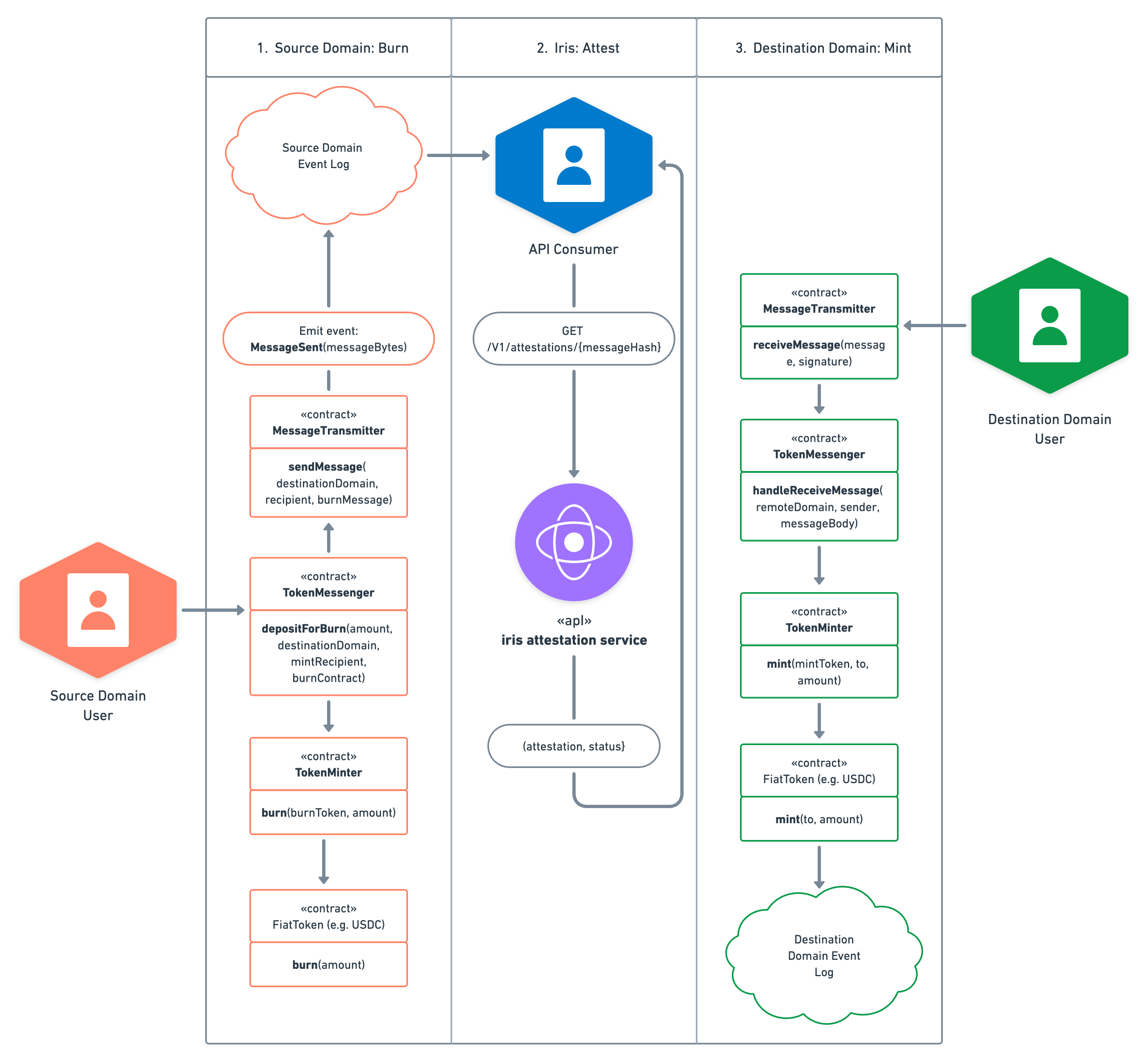 On EVM domains, the onchain component for cross-chain burning and minting is
called **TokenMessenger**, which is built on top of **MessageTransmitter**, an
onchain component for generalized message passing.
In the diagram above, a token depositor calls the
[TokenMessenger#depositForBurn](https://github.com/circlefin/evm-cctp-contracts/blob/adb2a382b09ea574f4d18d8af5b6706e8ed9b8f2/src/TokenMessenger.sol#L169)
function to deposit a native token (such as USDC), which delegates to the
**TokenMinter** contract to burn the token. The **TokenMessenger** contract then
sends a message via the
[MessageTransmitter#sendMessage](https://github.com/circlefin/evm-cctp-contracts/blob/adb2a382b09ea574f4d18d8af5b6706e8ed9b8f2/src/MessageTransmitter.sol#L108)
function. After
[sufficient block confirmations](/cctp/v1/required-block-confirmations),
Circle's offchain attestation service, Iris, signs the message. An API consumer
queries this attestation and submits it onchain to the destination domain's
[MessageTransmitter#receiveMessage](https://github.com/circlefin/evm-cctp-contracts/blob/adb2a382b09ea574f4d18d8af5b6706e8ed9b8f2/src/MessageTransmitter.sol#L250)
function. For more details, see
[Quickstart: Cross-chain USDC transfer](/cctp/v1/transfer-usdc-on-testnet-from-ethereum-to-avalanche).
To send an arbitrary message, directly call
[MessageTransmitter#sendMessage](https://github.com/circlefin/evm-cctp-contracts/blob/adb2a382b09ea574f4d18d8af5b6706e8ed9b8f2/src/MessageTransmitter.sol#L108).
Note that the message recipient must implement
[IMessageHandler#handleReceiveMessage](https://github.com/circlefin/evm-cctp-contracts/blob/master/src/interfaces/IMessageHandler.sol#L31C14-L31C34).
**Note:**
In CCTP V1, it is not possible to perform a burn-and-mint operation for USDC and
include arbitrary data in the same message. You must include arbitrary data in a
separate message. In later CCTP versions, you can burn-and-mint while including
data in the same message via Hooks.
### CCTP V1 on Non-EVM Domains
#### Noble
Noble is a Cosmos application-specific blockchain (or "appchain") that provides
native asset issuance for the Cosmos ecosystem. USDC is natively issued on Noble
and can be transferred via the Inter-Blockchain Communication (IBC) protocol to
other supported appchains in Cosmos, or via CCTP V1 to any supported domain (for
example, Ethereum).
Note that there are key differences between Cosmos appchains like Noble and
EVM-compatible blockchains. Unlike on EVM domains where CCTP V1 is a set of
smart contracts, CCTP V1 on Noble is a Cosmos SDK module, which is deployed by
Noble governance and built into the Noble blockchain. Cosmos appchains can use
IBC to build composable flows with CCTP V1 on Noble. Refer to the
[Noble documentation](/cctp/v1/noble-cosmos-module) for more details.
#### Solana
Solana is a layer-1 blockchain where USDC is natively issued as an SPL-token.
CCTP V1 is deployed to Solana as two Anchor programs: **MessageTransmitter** and
**TokenMessengerMinter**. Developers can compose programs on top of CCTP V1
programs through CPI's (Cross-Program Invocations). Arbitrary messages can be
sent directly by calling `MessageTransmitter#send_message` just as described in
the EVM section above. Refer to the
[Solana documentation](/cctp/v1/solana-programs) for more details.
#### Sui
Sui is another layer-1 blockchain where USDC is natively issued as a
[`Coin` implementation](https://docs.sui.io/standards/coin). CCTP V1 is deployed
to Sui as two programs: **MessageTransmitter** and **TokenMessengerMinter**.
Arbitrary messages can be sent by directly calling
`message_transmitter::send_message` similar to the EVM section above. Refer to
the [Sui documentation](/cctp/v1/sui-packages) for more details.
#### Aptos
Aptos is another layer-1 blockchain where USDC is natively issued as a
[`FA` implementation](https://aptos.dev/en/build/smart-contracts/fungible-asset).
CCTP V1 is deployed to Aptos as two programs: **MessageTransmitter** and
**TokenMessengerMinter**. Arbitrary messages can be sent by directly calling
`message_transmitter::send_message` similar to the EVM section above. Refer to
the [Aptos documentation](/cctp/v1/aptos-packages) for more details.
On EVM domains, the onchain component for cross-chain burning and minting is
called **TokenMessenger**, which is built on top of **MessageTransmitter**, an
onchain component for generalized message passing.
In the diagram above, a token depositor calls the
[TokenMessenger#depositForBurn](https://github.com/circlefin/evm-cctp-contracts/blob/adb2a382b09ea574f4d18d8af5b6706e8ed9b8f2/src/TokenMessenger.sol#L169)
function to deposit a native token (such as USDC), which delegates to the
**TokenMinter** contract to burn the token. The **TokenMessenger** contract then
sends a message via the
[MessageTransmitter#sendMessage](https://github.com/circlefin/evm-cctp-contracts/blob/adb2a382b09ea574f4d18d8af5b6706e8ed9b8f2/src/MessageTransmitter.sol#L108)
function. After
[sufficient block confirmations](/cctp/v1/required-block-confirmations),
Circle's offchain attestation service, Iris, signs the message. An API consumer
queries this attestation and submits it onchain to the destination domain's
[MessageTransmitter#receiveMessage](https://github.com/circlefin/evm-cctp-contracts/blob/adb2a382b09ea574f4d18d8af5b6706e8ed9b8f2/src/MessageTransmitter.sol#L250)
function. For more details, see
[Quickstart: Cross-chain USDC transfer](/cctp/v1/transfer-usdc-on-testnet-from-ethereum-to-avalanche).
To send an arbitrary message, directly call
[MessageTransmitter#sendMessage](https://github.com/circlefin/evm-cctp-contracts/blob/adb2a382b09ea574f4d18d8af5b6706e8ed9b8f2/src/MessageTransmitter.sol#L108).
Note that the message recipient must implement
[IMessageHandler#handleReceiveMessage](https://github.com/circlefin/evm-cctp-contracts/blob/master/src/interfaces/IMessageHandler.sol#L31C14-L31C34).
**Note:**
In CCTP V1, it is not possible to perform a burn-and-mint operation for USDC and
include arbitrary data in the same message. You must include arbitrary data in a
separate message. In later CCTP versions, you can burn-and-mint while including
data in the same message via Hooks.
### CCTP V1 on Non-EVM Domains
#### Noble
Noble is a Cosmos application-specific blockchain (or "appchain") that provides
native asset issuance for the Cosmos ecosystem. USDC is natively issued on Noble
and can be transferred via the Inter-Blockchain Communication (IBC) protocol to
other supported appchains in Cosmos, or via CCTP V1 to any supported domain (for
example, Ethereum).
Note that there are key differences between Cosmos appchains like Noble and
EVM-compatible blockchains. Unlike on EVM domains where CCTP V1 is a set of
smart contracts, CCTP V1 on Noble is a Cosmos SDK module, which is deployed by
Noble governance and built into the Noble blockchain. Cosmos appchains can use
IBC to build composable flows with CCTP V1 on Noble. Refer to the
[Noble documentation](/cctp/v1/noble-cosmos-module) for more details.
#### Solana
Solana is a layer-1 blockchain where USDC is natively issued as an SPL-token.
CCTP V1 is deployed to Solana as two Anchor programs: **MessageTransmitter** and
**TokenMessengerMinter**. Developers can compose programs on top of CCTP V1
programs through CPI's (Cross-Program Invocations). Arbitrary messages can be
sent directly by calling `MessageTransmitter#send_message` just as described in
the EVM section above. Refer to the
[Solana documentation](/cctp/v1/solana-programs) for more details.
#### Sui
Sui is another layer-1 blockchain where USDC is natively issued as a
[`Coin` implementation](https://docs.sui.io/standards/coin). CCTP V1 is deployed
to Sui as two programs: **MessageTransmitter** and **TokenMessengerMinter**.
Arbitrary messages can be sent by directly calling
`message_transmitter::send_message` similar to the EVM section above. Refer to
the [Sui documentation](/cctp/v1/sui-packages) for more details.
#### Aptos
Aptos is another layer-1 blockchain where USDC is natively issued as a
[`FA` implementation](https://aptos.dev/en/build/smart-contracts/fungible-asset).
CCTP V1 is deployed to Aptos as two programs: **MessageTransmitter** and
**TokenMessengerMinter**. Arbitrary messages can be sent by directly calling
`message_transmitter::send_message` similar to the EVM section above. Refer to
the [Aptos documentation](/cctp/v1/aptos-packages) for more details.